




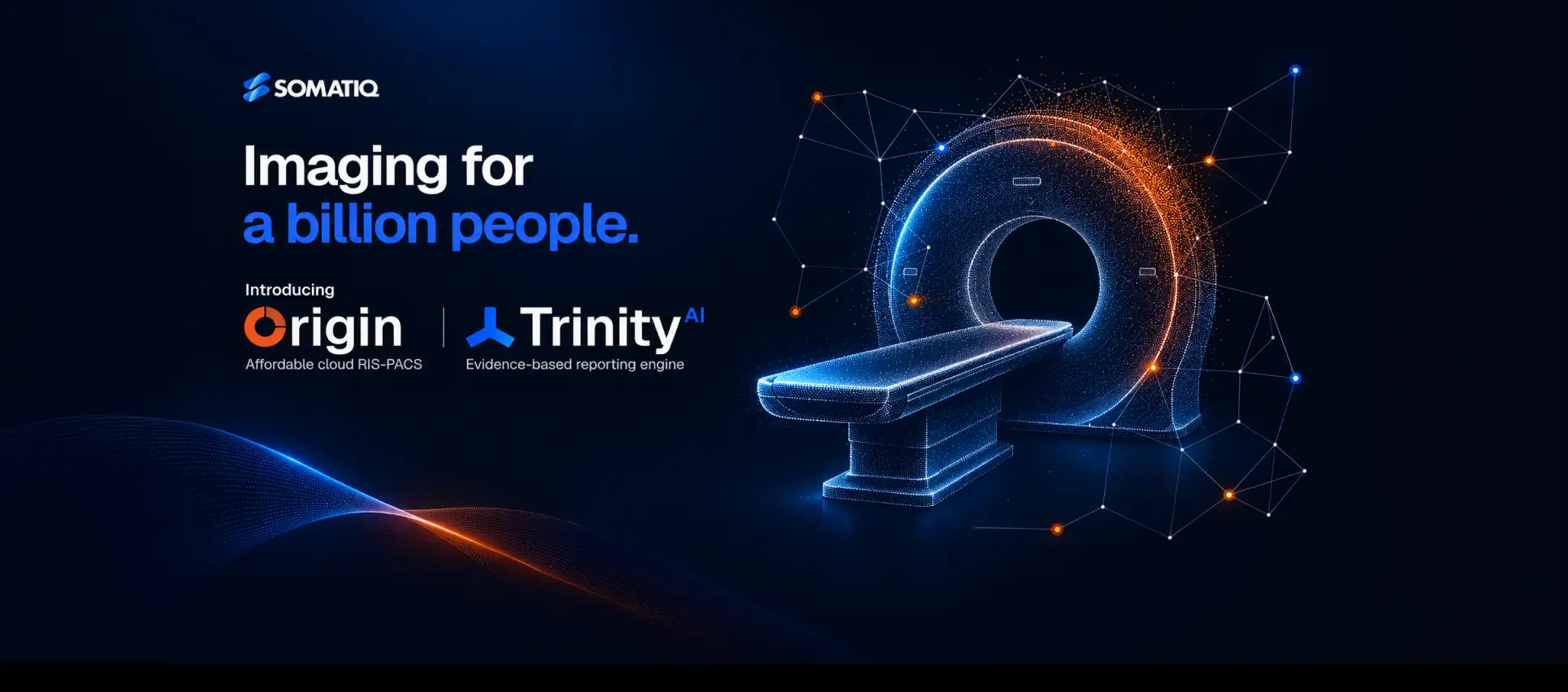
Somatiq Launches Origin and Trinity - Radiology Workflow and Reporting Engine to enable every Diagnostic Centre in India to go Digital
The Radiology Bottleneck
In Indian Healthcare software, there has an inverse relationship between sophistication and accessibility. For decades, deploying medical imaging infrastructure meant heavy capital expenditure: on-premise servers, expensive licensing agreements, and fragmented systems where the Radiology Information System (RIS) that handled billing didn't talk to the Picture Archiving and Communication System (PACS) that stored the scans. To make matters worse, the software was slow, buggy and hard to use.
This created a severe structural bottleneck, or what we call radiology’s digital divide. Large multi-specialty hospital chains in large metropolitan hubs could afford enterprise-grade software and dedicated IT teams. Meanwhile, small diagnostic centres in Tier 2 and Tier 3 cities, where a vast majority of the population seeks care, were priced out entirely, forced to rely on manual handoffs, CDs, and physical films.
In economic terms, this was a distribution failure born of legacy architecture. PACS was expensive because the delivery model required high-touch enterprise sales, local server maintenance, and fragmented add-ons for productivity tools like speech-to-text modules to enable faster report creation.
Somatiq’s launch of Origin and its Trinity Reporting Engine is a classic example of solving a distribution and architecture problem simultaneously. By shifting PACS, DICOM management, billing, and AI natively to the cloud in a self-serve, prepaid model, Somatiq is doing to legacy medical imaging what cloud infrastructure did to enterprise computing: moving it to an accessible utility available to any diagnostic centre from day one.
Somatiq, the Bengaluru company behind an AI-native RIS-PACS used by more than "x" imaging centres and "y" radiologists, is taking aim at radiology's digital divide. Origin puts a cloud DICOM PACS, AI, and speech-to-text within reach of the smallest centres in Tier 2 and Tier 3 towns. Trinity, a reporting engine built by a practising radiologist and tested on his own worklist for over a year, is now open to every Radiologist in India.
Fact Strip
- Products: Somatiq Origin and Trinity Reporting Engine
- For: Imaging centres of every size
- Included in Origin: Cloud DICOM PACS, AI-native workflow, speech-to-text reporting, and billing
- Used by: 130+ centres, 400+ radiologists across India
Radiology's Digital Divide Ends Here
In India, a patient's radiology depends entirely on their postcode. Large hospitals in the metros run advanced PACS and integrated AI. Many small centres in smaller towns still hand over physical films and CDs, because traditional PACS has always been expensive and are packaged primarily for enterprise budgets.
- PACS (Picture Archiving and Communication System): The digital storage and viewing system used by diagnostic centres to store, retrieve, and display medical images like X-rays, CT scans, and MRIs.
- DICOM (Digital Imaging and Communications in Medicine): The universal international standard format for handling, storing, and transmitting medical images.
- RIS (Radiology Information System): Software that manages patient scheduling, billing, and clinical workflow tracking within a diagnostic facility.
- AI-native: Software built from the ground up to integrate artificial intelligence into every core layer, rather than bolting it on as an afterthought.
- Worklist: The digital queue of patient cases awaiting review, interpretation, and sign-off by a radiologist.
Origin is Somatiq's answer to this disparity. Its goal is direct and inclusive: no diagnostic centre is too small to go digital.
AI is No Longer a Big-Hospital Privilege
Every Origin centre gets AI and speech-to-text reporting from its first day of deployment. A two-room centre in a Tier 3 town gets the exact same intelligent tooling as a multi-centre metropolitan chain.
Origin is built for self-serve onboarding. A centre signs up, configures its preferences, connects its imaging machines, and starts reporting immediately. Billing runs directly inside the same unified system, accommodating any number of staff members, with centres scaling usage through flexible prepaid case plans.
Built by a Radiologist on His Own Worklist
Most medical reporting software is designed by software engineers and handed down to clinicians with little regard for daily clinical ergonomics. Trinity was built the exact opposite way.
Dr. Vishwanath R S, Somatiq's co-founder and CEO and a practising radiologist, built Trinity using published radiology resources and established clinical standards. Before releasing it to anyone else, he tested and refined it on his own day-to-day clinical worklist for over a year. Trinity is now available to Radiologists in India.
Dr. Vishwanath R S, Co-Founder and CEO at Somatiq: "Trinity and Origin are the software I wish I had when I started by MD Radiology. We built it keeping in mind patient safety, Radiologist's productivity and at a cost structure that will work throughout India."
The Radiologist as the Decision Maker
Neither Origin nor Trinity removes the human expert from the loop. The software eliminates the administrative friction, high costs, and excessive clicks surrounding clinical judgement, allowing the radiologist to read every image, review every draft, and sign every final report with absolute precision.
Naveen, Co-Founder at Somatiq: "Being AI-native allows us to offer superior product experience for radiologists, diagnostic centre owners and patients".
About Somatiq
Somatiq is a Bengaluru-based health-tech company building an AI-native RIS-PACS and teleradiology platform to modernize medical imaging infrastructure. It is trusted by more than 130 imaging centres and 400 radiologists nationwide.
Stay tuned for more such updates on Digital Health News
Follow us